Guide · Updated
Substack welcome email examples (and how to write yours)
The short answer
A good Substack welcome email opens with a hook, not "Thanks for subscribing." Then it says who you are in one line, what new readers will get, and one thing to do next, like reply or read a starter post. Below are 5 real welcome posts from big Substacks and 8 fill-in templates that borrow their shapes.
Here's the catch with welcome emails: Substack only sends yours to new subscribers. So you can't scroll through other writers' welcome emails for ideas.
What you can read is the welcome post a lot of writers publish when they start. It does the same job in public. It says hi, tells you who's writing and makes you want the next one. So that's what I collected.
5 real welcome posts, 5 ways to open
Four are first posts. Margaret Atwood's is a welcome back, for when you restart. Each post links to the original. The counts are what each post showed when I checked it on Nov 28, 2026. Dates are the ones Substack shows, in US Pacific time.
1. Margaret Atwood: the welcome back
“I feel guilty about you, little Substack.”
Margaret Atwood on Substack posts · @margaretatwood, In the Writing Burrow · . 9,889 likes, 298 comments.
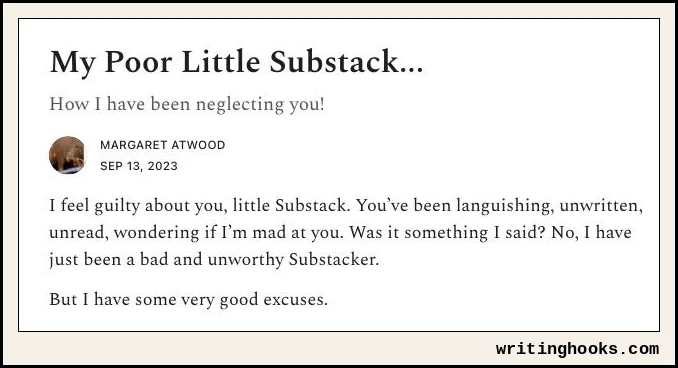
Post by Margaret Atwood on Substack, September 13, 2023. Why it works: She talks to her Substack like a pet she forgot to feed. It's funny, it owns up to being away, and you have to read her excuses. Later in the post she tells readers what they'll get and where paid subscriptions go (a bird charity).
2. Salman Rushdie: open with a family story
“Here is one of the stories my father liked to tell his friends:”
Salman Rushdie on Substack welcome posts · @salmanrushdie, Salman's Sea of Stories · . 3,161 likes, 108 comments.
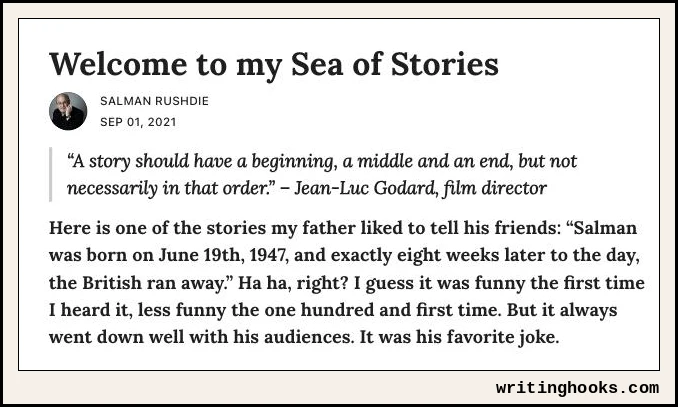
Welcome post by Salman Rushdie on Substack, September 1, 2021. Why it works: His newsletter is about stories, so he opens with one. The line ends on a colon, so you have to read the joke his dad told, and it tells you when he was born without a boring bio line. (The post starts with a short quote from a film director, then this line.)
3. Mayim Bialik: make the title a joke, then explain it
“Not my literal breakdown.”
Mayim Bialik on Substack welcome posts · @mayimbialik, Mayim Bialik · . 3,046 likes, 120 comments.
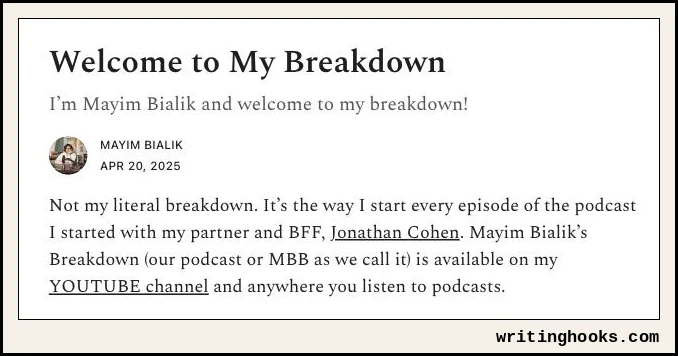
Welcome post by Mayim Bialik on Substack, April 20, 2025. Why it works: The title sounds alarming on purpose. Four words later she lets you off the hook and you smile. Then she explains: "Breakdown" is the name of her podcast.
4. Elizabeth Gilbert: say what it is, then hit hard in line two
“Self-loathing is a rampant virus in our contemporary culture — so prevalent as to have become the default setting in most of our minds.”
Elizabeth Gilbert on Substack welcome posts · @elizabethgilbert, Letters From Love with Elizabeth Gilbert · . 3,090 likes, 277 comments.
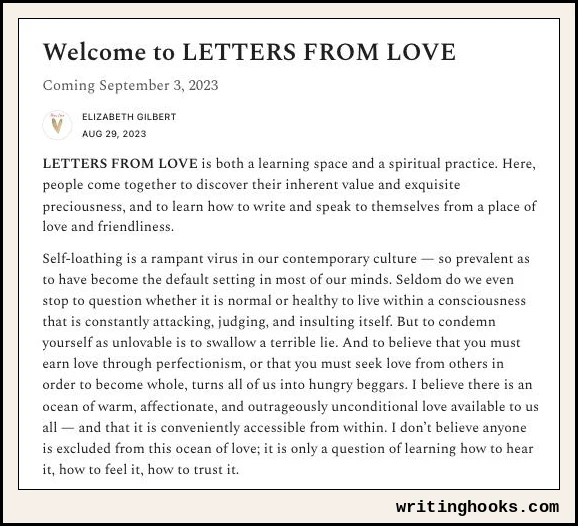
Welcome post by Elizabeth Gilbert on Substack, August 29, 2023. Why it works: Her first line says plainly what the newsletter is. The hook is line two: a bold claim a lot of readers have felt but never said out loud. Then she says she has written herself these letters for over a quarter of a century, so you trust her.
5. Sam Harris: admit what you missed
“My career and intellectual life have been built on the daily habits of reading and writing.”
Sam Harris on Substack welcome posts · @samharris, Sam Harris · . 2,468 likes, 116 comments.
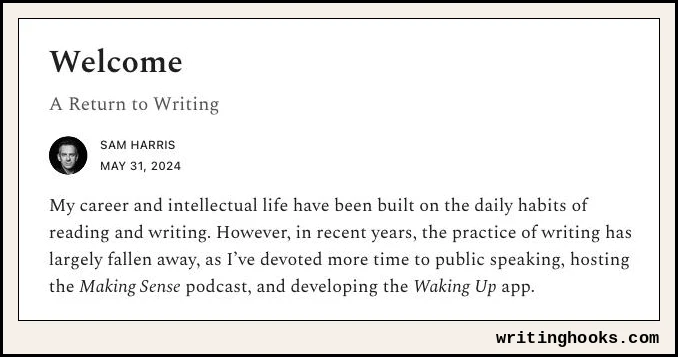
Welcome post by Sam Harris on Substack, May 31, 2024. Why it works: A calm, big claim about his life, then a twist: he stopped writing. Three lines later: "But I miss writing." That honest turn is why you keep going. Then a section called "What You Can Expect" tells new readers exactly what they signed up for.
Borrow the shape: 8 fill-in templates
Each one borrows a shape from the posts above, or a job every welcome email has to do. Swap the brackets for your own words.
1.“I owe you an apology, [newsletter name]. [Why you've been quiet, in one honest line].”
The comeback, like Margaret Atwood. Use it when you restart after a break. Owning up is a small story hook that makes them read line two.
2.“Here is a story my [family member] still tells about me: [the story, in one line].”
The family story, like Salman Rushdie. Pick one that hints at what you write about.
3.“Not [the scary or silly thing my newsletter name sounds like].”
The title joke, like Mayim Bialik. It only works if the title sets it up. A small curiosity gap, closed fast.
4.“[Newsletter name] is [what it is, in one line]. [One bold truth your readers feel but rarely say].”
Say what it is, then hit hard in line two, like Elizabeth Gilbert. Line two is a truth bomb.
5.“I used to [do this every day]. Then [life got in the way]. This newsletter is me getting it back.”
The confession, like Sam Harris. Honest beats impressive. See empathy hooks.
6.“You're in. Here's what lands in your inbox: [what you send], [how often].”
The promise. Only name a schedule you will really keep.
7.“Before anything else, hit reply and tell me [one easy question].”
The first job. A community invite turns a new reader into a pen pal.
8.“New here? Start with [post title]. It's the one readers [what they say about it].”
The starter post. One link, not ten.
How to write a Substack welcome email in 5 steps
- Open with a hook. Skip "Thanks for subscribing." Start with a story, a joke or an honest line, like the five posts above.
- Say who you are in one line. One line, not your whole bio. They just subscribed, so they already like you a little.
- Tell them what they get. What you write about and how often. Only promise a schedule you will keep.
- Give them one thing to do. Reply with an answer, read a starter post, or say hi in the comments. Pick one.
- Paste it into Substack. Go to your Settings, open the Emails section and click Edit next to the welcome email for free subscribers. Paid and imported subscribers get their own welcome emails there too.
Your welcome email is one hook. For the rest of your Substack, I have a guide on how to write Substack Notes, a page of Substack title ideas, and an email subject line challenge for the line that gets the email opened.
FAQ
- Where do I edit my Substack welcome email?
- In your Settings, under the Emails section. Click Edit next to the welcome email for free subscribers. If you have paid plans or imported a list, you will see separate welcome emails for those readers there too.
- Can I read other writers' welcome emails?
- Only by subscribing, because Substack sends them to new subscribers' inboxes. That's why the examples on this page are public welcome posts. They do the same job and anyone can read them.
- How long should a welcome email be?
- Short enough to read in a minute. The five posts above run from under 300 words to about 600, but those are posts. In an email, aim for the short end and link to a longer post if you need to.
- Should my welcome email ask people to pay?
- Only if you have paid plans, and keep it to one line. Substack's own guide suggests putting the upgrade button near the top for free subscribers. If everything you write is free, use that line to ask for a reply instead.