Guide · Updated
Open loop copywriting: how to keep people reading
The short answer
Open loop copywriting means you raise a question in the reader's head and hold the answer back until later. People hate an unfinished story, so they keep reading to close it. The trick is to close every loop you open, or readers stop trusting you.
A hook gets someone to read line one. An open loop gets them to read line ten. It's the same itch you get when a TV episode ends on a cliffhanger.
My curiosity gap page covers single hooks. This guide is about loops that run through a whole post: where to open them, how long to hold them and when to pay them off.
5 real open loops, and where each one closes
Three are Substack Notes and two are Substack posts. Each one links to the original. The counts are what each showed when I checked it on Nov 29, 2026. Dates are the ones Substack shows, in US Pacific time.
1. Johnny Cirillo: the story loop
“Sometimes the best part of taking someone's photograph happens after I put my camera down.”
Johnny Cirillo on Substack Notes · @watchingnewyork, Watching New York · . 19,600 likes, 780 replies.
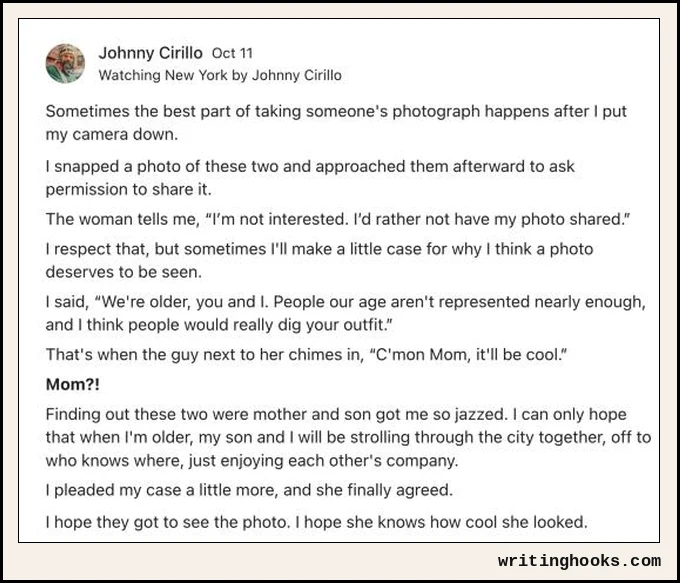
Note by Johnny Cirillo on Substack, October 11, 2026. Why it works: The line promises a "best part" and doesn't say what it is. He holds it through a no, a pitch and one more line, then closes it with one word: "Mom?!" The loop runs most of the Note, so you read all of it.
2. caroline ball: the twist loop, closed fast
“i saw a dad and a daughter at a coffee shop this morning.”
caroline ball on Substack Notes · @awalkingcontradiction, a walking contradiction · . 10,660 likes, 30 replies.
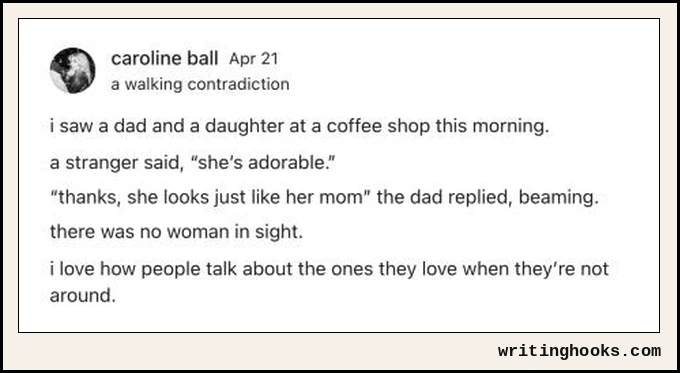
Note by caroline ball on Substack, April 21, 2026. Why it works: A plain scene with no hint of a twist. Then the dad says his daughter looks just like her mom, and that opens a small question: where is she? Line four answers it: "there was no woman in sight." The last line tells you what it means. Five short lines, one loop, closed before you can scroll away.
3. Archer Parquette: the loop hidden in a list
“Things I've Noticed Since Quitting Social Media:”
Archer Parquette on Substack Notes · @archerp, Worthless Trash · . 3,226 likes, 137 replies.
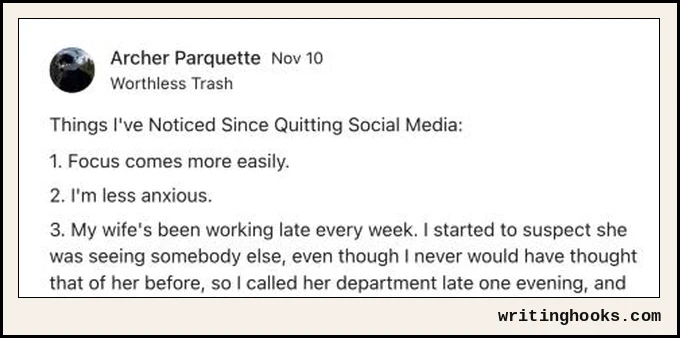
Note by Archer Parquette on Substack, November 10, 2026. Why it works: Items 1 and 2 are what you expect: "Focus comes more easily" and "I'm less anxious." Item 3 opens a loop ("I started to suspect she was seeing somebody else") and runs for hundreds of words into a horror story. Item 4 snaps back: "I don't check my phone so often." The list sets a pattern, so the loop in item 3 hits harder when it breaks it.
4. Mackensie D.: one loop across a whole post
HeadlineI Spent Hours Studying Why Things Go Viral. Here's What I Found.
Hook“Lately I’ve been making a more intentional effort to learn.”
Mackensie D. on Substack posts · @mackensiedebello, ☆ Mackensie ☆ · . 7,971 likes, 233 comments.
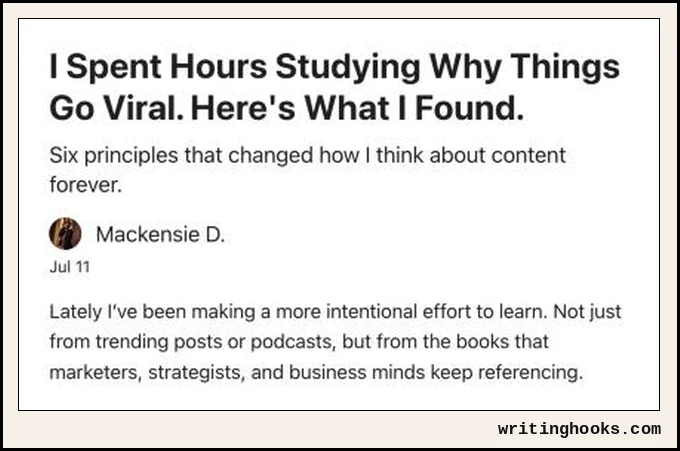
Post by Mackensie D. on Substack, July 11, 2026. Why it works: The title opens the big loop: what did she find? The intro hints at "a framework I haven't been able to stop thinking about" for four paragraphs before naming it (STEPPS, from Jonah Berger's book Contagious). Then each of the six letters gets its own heading, so every section opens a small loop the next paragraph closes. The last heading, "So What Does This Mean for You?", closes the big one.
5. Vels Visions: the question loop
HeadlineYou Seem Pretty Unmotivated for a Girl So Desperate for Success
Hook“Do you ever feel like you have so many places to go, yet every morning you wake up in the exact same location?”
Vels Visions on Substack posts · @velsvisions, Vels Visions · . 50,200 likes, 581 comments.
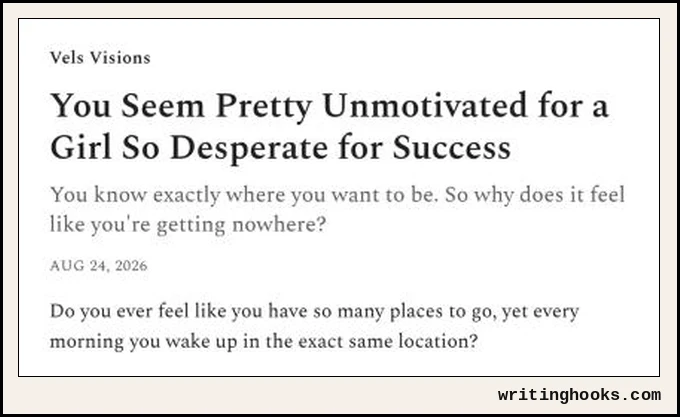
Post by Vels Visions on Substack, August 24, 2026. Why it works: It's a question you answer "yes" to in your head. Once you've said yes, you want to know why it happens and what to do. The subtitle opens the same loop: "So why does it feel like you're getting nowhere?" Near the end she names the close you expect, a "you can do it!", and swaps it for a different one. Closing a loop in a way readers don't see coming is fine. Leaving it open is not.
Borrow the shape: 8 fill-in templates
Each one borrows a shape from the examples above, or a loop every writer can use. Swap the brackets for your own words, and know where the loop closes before you start.
1.“The best part of [thing you do] happened after [the moment it should have ended].”
The story loop, like Johnny Cirillo. Close it with one line that surprises. See story hooks.
2.“[A plain scene, in one line]. Then [someone] said, "[a line that raises a question]."”
The twist loop, like caroline ball. Answer the question in the very next line.
3.“Things I've noticed since [a change]: 1. [expected] 2. [expected] 3. [the one that turns into a story]”
The list loop, like Archer Parquette. Two normal items set the pattern so the third can break it. See list hooks.
4.“I spent [real amount of time] studying [topic]. Here's what I found.”
The research loop, like Mackensie D. Only use it if you did the work, and name what you found early.
5.“Do you ever feel like [a common feeling], yet [the thing that doesn't add up]?”
The question loop, like Vels Visions. Ask something your reader will say yes to.
6.“There are [number] reasons [result]. The last one is the one nobody talks about.”
The countdown loop. Put your best point last and keep the list short. See numbers hooks.
7.“I'll tell you what [person] said in a minute. First, [the setup].”
The held answer. Keep the wait to a few lines, or it feels like a trick.
8.“Everyone told me to [common advice]. I did the opposite. Here's what happened.”
The contrarian loop. The "what happened" has to be real. See contrarian hooks.
How to use open loops in 5 steps
- Open the loop in your hook. Ask a question, start a story, or name a result without the how.
- Pick where it closes. Know the exact line that answers it before you write the middle.
- Hold it, but not too long. In a Note, a few lines. In a post, a few paragraphs. If the middle is filler, people leave.
- Stack small loops. Each heading or list item can open a little loop the next paragraph closes, while the big one stays open.
- Close every loop. Pay off what you promised. A loop you never close feels like clickbait.
Every loop starts with a hook. For one-line openers, see my curiosity gap hooks. To see how the headline and the hook split the job, read hook vs headline. Or browse the hook library for loops to borrow.
FAQ
- What is an open loop in copywriting?
- A question or story you start and don't finish right away. The reader keeps going to find the end.
- What's the difference between an open loop and a curiosity gap?
- A curiosity gap is usually one line, one hook. An open loop can run through a whole post, and you can stack several. Every curiosity gap opens a loop, but not every loop is a one-line gap.
- Why do open loops work?
- People remember unfinished things better than finished ones. Psychologists call this the Zeigarnik effect, after Bluma Zeigarnik, who studied it. An open loop puts that pull to work.
- Is an open loop clickbait?
- Only if you never close it. Clickbait promises and doesn't pay. An open loop promises and pays, a few lines or a few paragraphs later.
- How many open loops should one post have?
- One big loop that runs the whole post, plus small ones in headings or list items. If readers lose track of what you promised, you have too many.